

Introduction
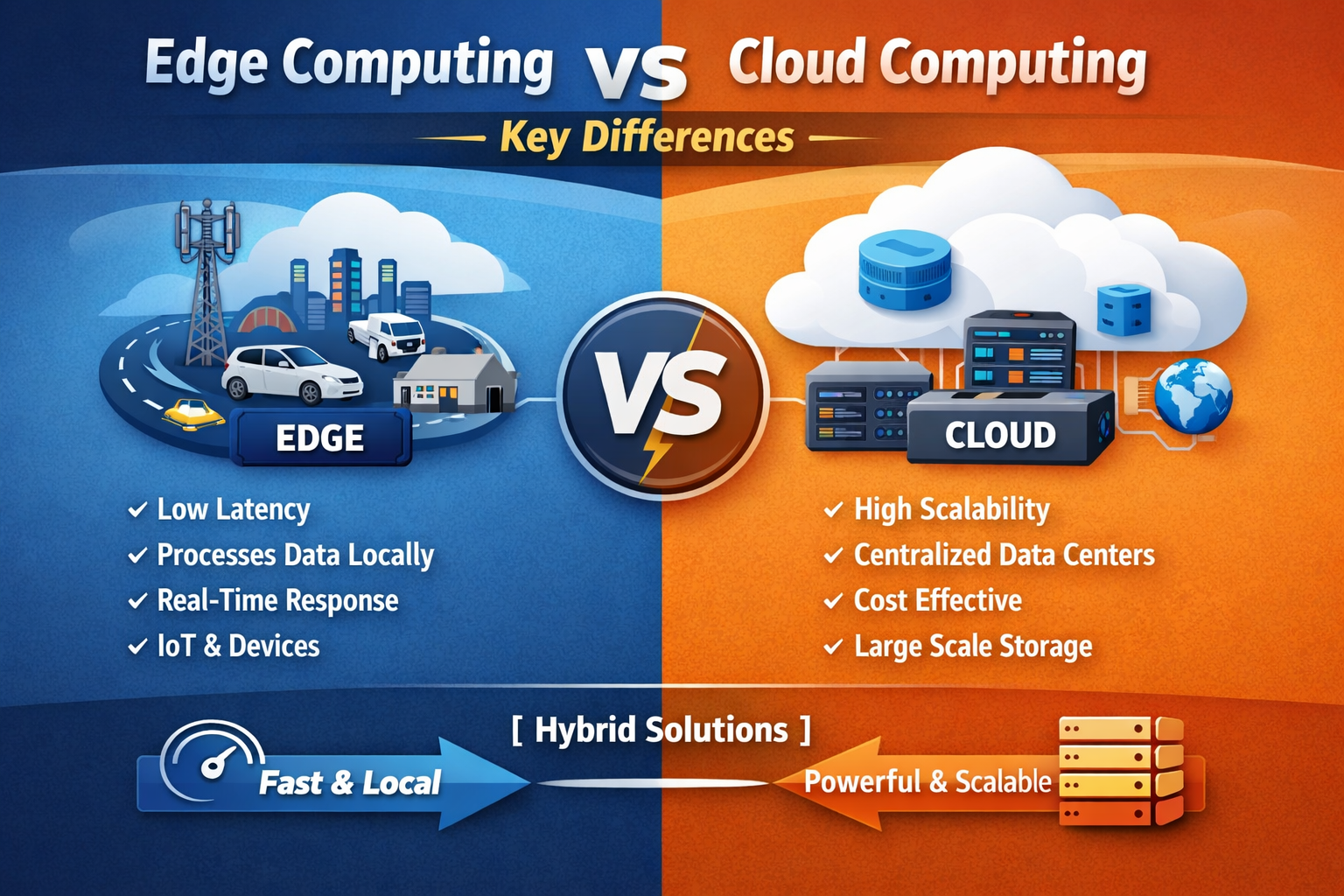
In today’s digital era, the terms edge computing vs cloud computing are often used interchangeably, yet they serve different purposes in the computing ecosystem. Both approaches aim to process data efficiently, but the methodology, speed, and use cases vary significantly. Businesses and developers must understand the differences to leverage the right technology for their applications.
What is Cloud Computing?
Cloud computing refers to the delivery of computing services—servers, storage, databases, networking, software, and more—over the Internet, commonly known as “the cloud.” It allows businesses to access powerful resources without maintaining physical infrastructure. Services are typically offered by providers like Amazon Web Services (AWS), Microsoft Azure, and Google Cloud.
- Cloud computing centralizes data in remote servers.
- It offers scalability, allowing businesses to handle large workloads on-demand.
- Security and maintenance are largely managed by cloud providers.
- Applications and data are accessible from anywhere with an internet connection.
- Pay-as-you-go pricing models reduce upfront IT costs.
Cloud computing centralizes data on remote servers, offering scalability and easy accessibility for businesses.
What is Edge Computing?
Edge computing brings computation closer to the data source. Rather than sending all data to centralized servers, processing occurs near the device generating the data. This approach reduces latency, improves response times, and optimizes bandwidth usage, making it ideal for IoT devices, autonomous vehicles, and real-time analytics.
Key Features of Edge Computing:
- Processes data near the source device.
- Reduces latency for time-sensitive applications.
- Minimizes bandwidth usage by avoiding excessive data transfer.
- Enhances privacy and security for sensitive data.
- Integrates with cloud computing for hybrid solutions.
Edge computing reduces latency and improves speed by processing data near its source, enhancing real-time decision-making.
Edge Computing vs Cloud Computing: Key Differences
| Feature | Cloud Computing | Edge Computing |
|---|---|---|
| Location | Centralized data centers | Near data source (edge devices) |
| Latency | Higher latency | Low latency, near real-time |
| Scalability | Easily scalable | Limited by edge device capacity |
| Data Processing | Bulk processing | Real-time, localized processing |
| Cost | Pay-as-you-go | High initial device cost, lower bandwidth cost |
From this table, it is clear that while cloud computing is ideal for massive storage and analytics, edge computing shines in scenarios demanding low latency and immediate processing. Businesses often use a hybrid model combining both approaches for optimal performance.
Benefits of Cloud Computing
Cloud computing offers a multitude of advantages that make it attractive for enterprises:
- Scalability: Easily scale resources up or down based on demand.
- Cost Efficiency: Reduces the need for expensive physical infrastructure.
- Reliability: Data redundancy ensures business continuity.
- Accessibility: Users can access applications and data from anywhere.
- Managed Services: Cloud providers handle updates, security, and maintenance.
Benefits of Edge Computing
Edge computing provides distinct advantages in modern digital ecosystems:
- Reduced Latency: Near-instant data processing for real-time applications.
- Bandwidth Optimization: Less data is sent to central servers.
- Enhanced Security: Sensitive data can remain localized.
- Better Reliability: Edge devices can continue functioning even when offline.
- Integration Flexibility: Works alongside cloud infrastructure for hybrid solutions.
Edge computing improves security and reliability by processing sensitive data locally while minimizing network usage.
Use Cases of Cloud Computing
Cloud computing is suitable for scenarios where massive data storage and complex processing are required:
- Enterprise resource planning (ERP) software
- Big data analytics
- SaaS applications like Office 365 or Salesforce
- Online backup and disaster recovery solutions
- Streaming services like Netflix and Spotify
Use Cases of Edge Computing
Edge computing is designed for situations requiring low latency and fast decision-making:
- Autonomous vehicles requiring instant sensor data processing
- Smart factories using IoT devices for real-time monitoring
- Healthcare devices analyzing patient data on-site
- Retail stores implementing AI-powered customer insights
- Remote surveillance and security monitoring systems
| Use Case | Cloud Computing | Edge Computing |
|---|---|---|
| Data Storage | ✔️ Large-scale storage | Limited, device-based storage |
| Real-Time Processing | ❌ Not optimal | ✔️ Ideal for instant decision-making |
| Bandwidth Usage | High | Low |
| Scalability | Excellent | Limited by hardware |
Challenges in Cloud Computing
While cloud computing offers multiple benefits, it comes with challenges:
- Latency Issues: Real-time applications may suffer due to network delays.
- Bandwidth Dependency: Requires a stable, high-speed internet connection.
- Data Privacy Concerns: Centralized storage may pose security risks.
- Cost Fluctuations: Pay-as-you-go pricing can escalate with heavy usage.
Challenges in Edge Computing
Edge computing is not without its limitations:
- High Initial Costs: Deploying edge devices can be expensive.
- Limited Scalability: Edge devices cannot match the cloud’s scale.
- Management Complexity: Monitoring and maintaining multiple devices is challenging.
- Integration: Requires hybrid strategies to fully leverage cloud capabilities.
Edge Computing and Cloud Computing: Complementary Roles
The future often lies in combining edge computing vs cloud computing. Edge handles real-time, low-latency tasks while the cloud manages heavy computation, long-term storage, and analytics. For example:
- IoT Smart Homes: Edge devices process immediate sensor data, while the cloud stores historical trends.
- Healthcare: Wearable devices analyze health metrics locally; aggregated data is sent to the cloud for research.
- Retail: In-store AI systems act in real-time, while sales data is centralized in the cloud.
This hybrid approach leverages the strengths of both technologies.
Key Considerations for Businesses
When deciding between edge and cloud computing, businesses should evaluate:
- Latency Requirements: How quickly does data need processing?
- Data Sensitivity: Does privacy require local processing?
- Infrastructure Costs: What is the budget for devices vs cloud services?
- Scalability Needs: Will demand fluctuate heavily?
- Hybrid Potential: Can edge and cloud complement each other effectively?
Businesses must assess latency, security, and scalability when choosing between cloud and edge computing.
Future Trends in Edge and Cloud Computing
- AI at the Edge: Increasing deployment of AI models on edge devices.
- 5G Integration: Faster networks will reduce cloud latency but enhance edge capabilities.
- Hybrid Cloud-Edge Platforms: More platforms will offer seamless integration.
- IoT Expansion: Growing IoT adoption will drive edge computing demand.
- Energy Efficiency: Both technologies will focus on sustainable, low-power solutions.
Conclusion
Understanding edge computing vs cloud computing is crucial for modern enterprises seeking to optimize performance, reduce costs, and ensure security. Cloud computing excels in massive storage, scalability, and managed services, whereas edge computing offers speed, low latency, and localized data processing. The trend is increasingly toward hybrid models, leveraging both approaches for real-time insights and large-scale data management. Businesses that carefully evaluate their latency needs, budget, data sensitivity, and scalability requirements can create a computing strategy that combines the best of both worlds.
By strategically implementing edge and cloud technologies, organizations can future-proof operations, enhance customer experiences, and drive innovation in a digital-first economy. As industries continue to evolve, the interplay between edge and cloud computing will remain a cornerstone of technological growth and business efficiency.
Leveraging both edge and cloud computing enables businesses to optimize performance, security, and scalability simultaneously.
Read More:- Mastering Software Development: Trends, Tips & Techniques